
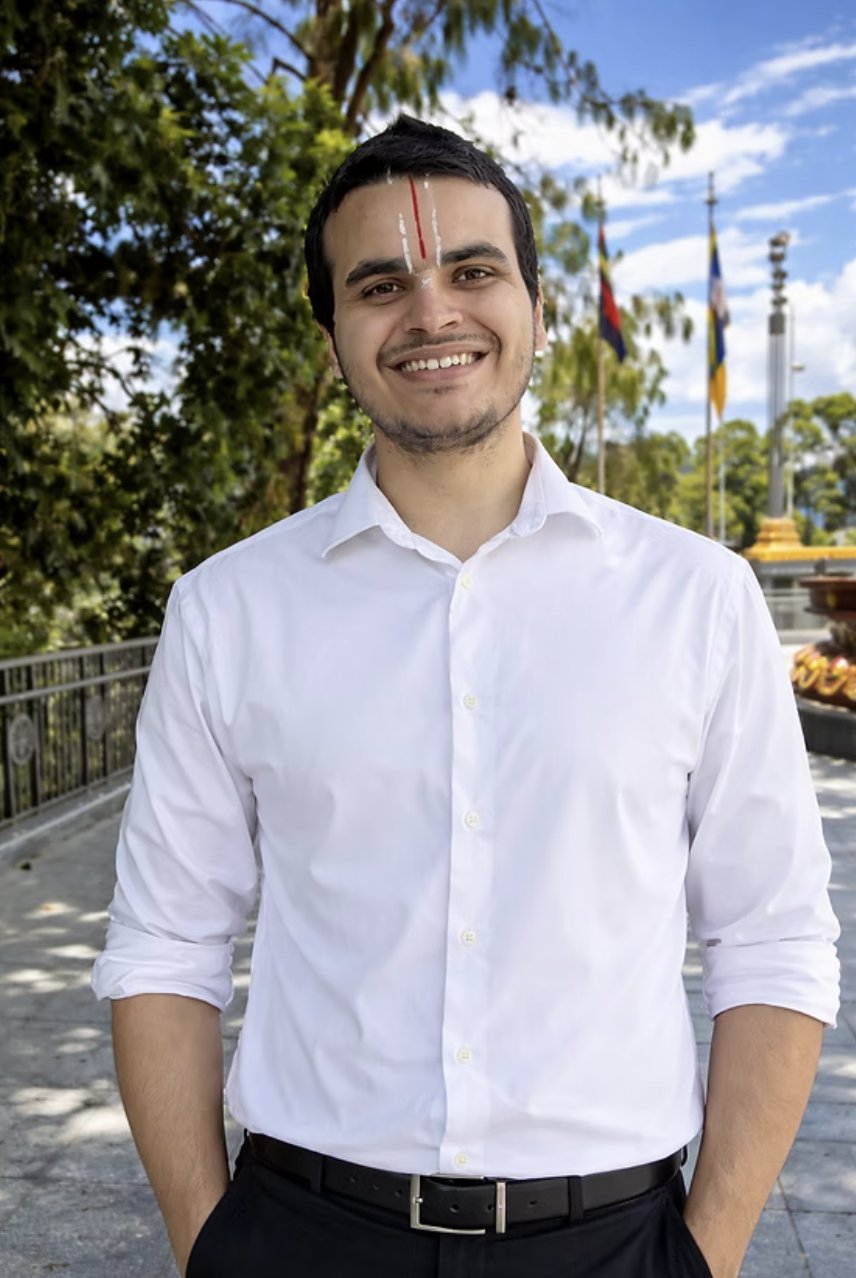
Vedic counselling, as Dev practises it, is psychotherapy with a trained psychologist who also uses the Bhagavad Gītā, the Yoga Sūtras and Vedānta as working frameworks for understanding the mind. The psychological work comes first: what is happening, how it began and what keeps it going. The texts come in where they help. He calls the method Dev’s Vedic Therapy (DVT).
Who you would be working with
- MSc in Psychology with Distinction, Anglia Ruskin University, Cambridge. Graduate Member of the British Psychological Society (GMBPsS).
- Over nine years of study in Vedānta and Yoga. Head instructor at a yoga school from 2018 to 2022, teaching on 500-hour yoga teacher-training courses.
- He learnt spoken Sanskrit for his MSc fieldwork in Mattur, Karnataka, a study of Vedic chanting and cognition that is now under peer review.
- In clinical practice in Gangtok since October 2023.
Who comes for this?
- People who know the teaching and cannot live it when things go wrong. They have read the Gītā or sat with a teacher for years, and it does not hold when life becomes hard.
- People for whom meditation has stopped working, or never worked.
- People whose earlier therapy helped the symptoms and left the larger questions alone.
Some have had years of conventional therapy and want an Eastern framework added to it. Some have never seen a therapist and would only see one who takes their practice seriously.
What happens in a session?
The first full session is about understanding: what the issues are, how you are feeling, what you think the problem is and how you have tackled it before. Breathing and meditation are taught step by step, chosen for the person. The ideas come later, and only for those who want them. In Dev’s words:
Eventually, for those who are interested, I teach the ideas themselves: what the śāstra and the Vedic paradigm say about the mind.
— Devdarshan Bastola
How the sessions work sets out the first call, the first session and how often you meet.
How are the texts used? Three examples
Each of these is set out at length in an essay.
The Gītā on rumination. Verses 2.62–63 describe a chain that runs from dwelling on a thing to attachment, desire, anger, confusion and the loss of judgement. In therapy the chain is a map. It shows where a spiral of thought begins, and the earliest point at which it can be interrupted. What the Gītā says about overthinking · the full essay
Patañjali’s five kleśas. The Yoga Sūtras name five roots of suffering: not seeing clearly, the sense of “I”, attachment, aversion and the fear of ending. They give a way of asking what lies beneath a symptom. The essay on the five kleśas
Pratyāhāra and attention. Pratyāhāra is the practice of drawing attention back from the senses. It is taught as a skill that can be trained, close to what modern attention training does for anxiety. The essay on pratyāhāra
The other essays cover dhyāna and mindfulness, saṅkalpa and lasting change, tapas and discomfort, santoṣa, śraddhā and trust in therapy, aparigraha and letting go, and vāsanā, saṃskāra and trauma.
Do I need to be Hindu?
No. People of every faith and of none are welcome, and nothing devotional is asked of anyone. In Dev’s words:
For those who are not Hindu, there are other paradigms of thought which serve the same purpose.
— Devdarshan Bastola
If you searched for a Hindu therapist
People look for a Hindu therapist for a simple reason. They want to speak about karma, dharma, family duty, a guru or a vow without first having to explain it. Dev has studied and practised within the tradition for over nine years. Where your faith is part of the difficulty, or part of what helps, it is part of the work.
Other names for this kind of work
In the West this kind of work is often called spiritually integrated psychotherapy. Therapy informed by Advaita Vedānta is sometimes called nondual therapy. Yoga psychology and “an Eastern approach to therapy” describe overlapping ground. The term Vedic counselling is also used for lifestyle and spiritual guidance of other kinds. On this site it means psychological work with a psychologist.
Does this kind of therapy work?
A 2018 analysis of 97 studies, covering more than 7,000 people, looked at therapy adapted to a client’s religion or spirituality. In the more rigorous studies it reduced distress as well as standard therapy did, and it improved spiritual well-being more (Captari and colleagues, Journal of Clinical Psychology, 2018). Research on therapy adapted specifically for Hindu clients is still at an early stage. No outcome can be promised for any one person.
Times and fees
Sessions start between 4 and 8 PM India time every day, and between 6:30 and 9:30 AM India time on Fridays and Sundays.